

As a supplier of Lift Welding Production Lines, I've had the privilege of witnessing firsthand the pivotal role that welding torches play in the efficiency and quality of the production process. In this blog, I'll delve into the essential requirements for welding torches in a lift welding production line, drawing on my years of experience in the industry.
1. Welding Torch Compatibility with Lift Welding Processes
In a lift welding production line, different types of welding processes are often employed, such as MIG (Metal Inert Gas), TIG (Tungsten Inert Gas), and MAG (Metal Active Gas) welding. The welding torch must be fully compatible with the specific welding process used. For instance, MIG welding torches are designed to handle the continuous feeding of welding wire, which is essential for high - speed welding operations commonly found in lift production. They need to be able to maintain a stable wire feed rate, ensuring smooth and consistent welds.
TIG welding torches, on the other hand, are more suitable for precision welding tasks, such as welding thin sheets or components with tight tolerances in lift structures. These torches require a high - quality tungsten electrode holder and a well - designed gas nozzle to provide proper shielding gas coverage. The torch should also be able to handle the high temperatures generated during TIG welding without overheating, which could affect the quality of the weld and the lifespan of the torch.
2. Heat Resistance and Cooling Capabilities
Lift welding production lines often involve long - term, high - intensity welding operations. As a result, the welding torch must have excellent heat resistance and cooling capabilities. Excessive heat can cause the torch components to expand, leading to misalignment and reduced welding accuracy. It can also damage the insulation and other internal parts of the torch, shortening its service life.
To address these issues, many modern welding torches are equipped with advanced cooling systems. Water - cooled torches are a popular choice in lift welding production lines. They use a continuous flow of water to dissipate heat from the torch, ensuring that it remains at a stable operating temperature. This not only improves the quality of the weld but also allows for longer periods of continuous welding without the need for frequent breaks to cool down the torch.
3. Durability and Reliability
The welding torch is a critical component in the lift welding production line, and any breakdown or malfunction can lead to costly production delays. Therefore, durability and reliability are of utmost importance. The torch should be constructed from high - quality materials that can withstand the harsh conditions of the welding environment, including exposure to high temperatures, sparks, and welding fumes.
The cable and connectors of the welding torch also need to be durable. They should be resistant to abrasion, bending, and twisting, which are common during the movement of the torch in the production line. Additionally, the torch should have a reliable trigger mechanism that can withstand repeated use without failure. A well - designed trigger ensures precise control of the welding process, allowing operators to start and stop the welding arc accurately.

4. Ergonomics and Operator Comfort
In a lift welding production line, operators often need to hold and manipulate the welding torch for extended periods. Therefore, the ergonomics of the torch are crucial for operator comfort and productivity. A well - designed welding torch should have a comfortable grip that fits the natural shape of the operator's hand. It should also be lightweight to reduce fatigue during long - term use.
The torch's controls, such as the trigger and gas flow adjustment knob, should be easily accessible and intuitive to use. This allows operators to make quick adjustments to the welding parameters without having to take their eyes off the welding area, improving both safety and efficiency.
5. Welding Torch Flexibility and Reach
Lift structures can be complex, with various components and hard - to - reach areas. The welding torch must have sufficient flexibility and reach to access these areas. Some welding torches are designed with flexible gooseneck or articulated arms, which allow operators to position the torch at different angles and reach tight spaces.
This flexibility is especially important when welding internal components or corners of lift parts. It enables operators to achieve consistent welds in all areas of the lift structure, ensuring the overall quality and integrity of the final product.
6. Compatibility with Automation Systems
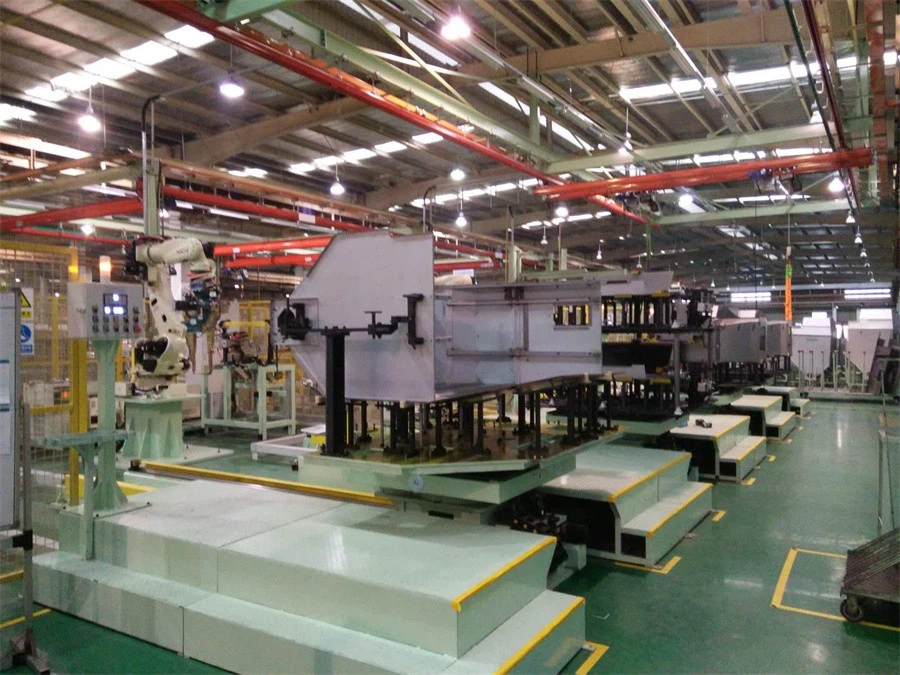
Many modern lift welding production lines are equipped with automation systems, such as robotic welding arms. The welding torch must be compatible with these automation systems to ensure seamless integration. This includes having the appropriate mounting interfaces and communication protocols to allow the torch to be controlled by the robotic system.
The torch should also be able to provide feedback on its status, such as temperature, gas flow rate, and wire feed speed, to the automation system. This information can be used to adjust the welding parameters in real - time, ensuring optimal welding quality and efficiency.
7. Cost - effectiveness
While quality and performance are essential, cost - effectiveness is also a significant consideration for lift welding production line suppliers. The welding torch should offer a good balance between price and performance. It should be reasonably priced without sacrificing the necessary features and capabilities.
When evaluating the cost - effectiveness of a welding torch, it's important to consider not only the initial purchase price but also the long - term operating costs. A high - quality torch may have a higher upfront cost but can save money in the long run by reducing maintenance and replacement costs, as well as improving production efficiency.
Conclusion
In conclusion, the requirements for the welding torch in a lift welding production line are diverse and demanding. It must be compatible with the welding process, have excellent heat resistance and cooling capabilities, be durable and reliable, offer good ergonomics, have sufficient flexibility and reach, be compatible with automation systems, and be cost - effective.
As a supplier of Lift Welding Production Lines, we understand the importance of choosing the right welding torch for our customers. We offer a wide range of welding torches that meet these requirements, ensuring that our customers can achieve high - quality, efficient, and cost - effective lift welding operations.
If you're interested in learning more about our Lift Welding Production Lines or our selection of welding torches, or if you have any questions about the requirements for welding torches in your specific production line, please feel free to [initiate a contact for procurement negotiation]. We also provide other types of welding production lines, such as the Agricultural Machinery Welding Production Line, Energy Storage Box Welding Production Line, and Elevator Door Panel Welding Production Line.
References
- AWS Welding Handbook, American Welding Society
- Welding Technology: Principles and Applications, John A. Schey
- Modern Welding Processes, Richard L. Petzold